

How to Choose Which Greek Islands to Visit (Without Regret)

This page may contain affiliate links. As an Amazon Associate, I earn from qualifying purchases. If you click on a link and make a purchase, I may receive a small commission at no extra cost to you. Thanks for supporting my work! You can read more in my Privacy Policy.
You’ve decided you’re going to Greece. Amazing!
But now comes the part that stops most people cold: how do you choose which Greek islands to visit when there are over 6,000 of them?
You open a tab. Then another.
Then 17 more.
Santorini keeps showing up everywhere, but someone on Reddit said it’s overrated.
Crete sounds incredible, but it’s huge.
And now someone’s mentioned the Ionian islands and you didn’t even know those were a different thing.
The best approach is to work backward from your trip length, pick one island region, and match your islands to the experience you actually want, not the one Instagram tells you to have.
After 5 years of annual trips to Greece and one spectacularly failed attempt to cram London, Paris, Athens, and Naxos into a single trip (spoiler: I got the flu), I built a 7 step framework that makes this decision feel manageable instead of paralyzing.
You’ll figure out how many islands your trip can realistically handle, which region to focus on, what vibe you’re actually after, and how to pair islands that complement each other instead of repeating the same experience twice.
Here’s what we’re working through:
- Start with your days. Your trip length decides your island count before anything else.
- Pick your region first. Not all islands are close together, and mixing regions can cost you a full travel day.
- Choose your vibe. Dramatic sunsets, quiet harbors, or rugged coastline? The right feeling narrows the list fast.
- Lock in your non negotiables. The one thing you’d regret missing will point you straight to the right island.
- Match your transport style. Some islands are walkable. Others need a car or you’ll miss the best parts.
- Be honest about coming back. You don’t have to see everything this time.
- Balance your islands. Contrast beats repetition every single time.
Step 1: How Many Greek Islands Should You Visit? Start With Your Days

Everything starts here.
Not with which island is prettiest.
Not with what you saw on Instagram.
Days first, islands second.
The number of days you have will immediately cut your list in half.
Here’s the simple math I use with every trip I plan:
- 7 days: Athens plus 1 island
- 10 days: Athens plus 2 islands
- 14 days: 2 to 3 islands max
If you’re a family coordinating school schedules and work PTO, that 10 to 14 day window is usually the sweet spot.
Planning a trip to Greece involves a lot of moving pieces beyond just islands, and your available days are the foundation for all of it.
14 days can work for 3 islands, but only if they’re in the same region and well connected by ferry.
What people don’t account for is that every island change costs you almost a full day.
You have to pack up, check out, get to the port or airport, wait, travel, transfer to your hotel, and check in.
Even a “quick” ferry can turn into 5 to 6 hours door to door.
Which is why I have a three night minimum rule for every island.
I once booked a one night stay in Santorini between ferries thinking it was efficient.
We spent more time coordinating luggage storage and transfers than actually seeing the caldera.
One night on an island isn’t a visit. It’s a layover with a view.
Give yourself permission to see less and actually experience it.
Step 2: Choose a Greek Island Region Before You Choose an Island

This is the step most people skip. And it’s the one that causes the most chaos.
Greece is big. Like, way bigger than most people realize.
The island groups are spread across two different seas.
And mixing regions usually means flying back through Athens or committing to a full day of travel between islands.
One of the most common things I see when reviewing itineraries is people trying to combine Santorini and Corfu in the same trip.
I get why.
Both are stunning, both are bucket list worthy, and when you’re deep in the research spiral, all Greek islands start to feel like they’re in the same neighborhood.
They’re not remotely.
Those islands are in completely different regions, connected by completely different logistics.
Greek island hopping between them means flying back through Athens and burning a full travel day just to change seas.
That’s a day you could’ve spent actually being somewhere, eating something delicious, or doing absolutely nothing on a gorgeous beach.
So before you fall in love with a specific island, zoom out and pick your region first.
If this is your first trip to Greece, these are the 3 regions that matter most:
The Cyclades (Santorini, Mykonos, Naxos, Paros): The iconic white and blue postcard Greece, and the most ferry connected cluster, which makes island hopping easier.
The Ionian Islands (Corfu, Kefalonia, Zakynthos): Lush, green, and turquoise.
Completely different landscapes and better accessed by flight than ferry from Athens.
Crete: Big enough to be its own trip. You don’t “hop” Crete. You explore it.
Once you pick a region, you’ve already eliminated half the map.
That’s not limiting your trip. That’s saving it.
Not sure which islands belong to which region?
The Greek island regions are more distinct than most people realize, and knowing the differences makes this whole decision easier.
Step 3: Decide What You Want Your Greek Island Trip to Feel Like
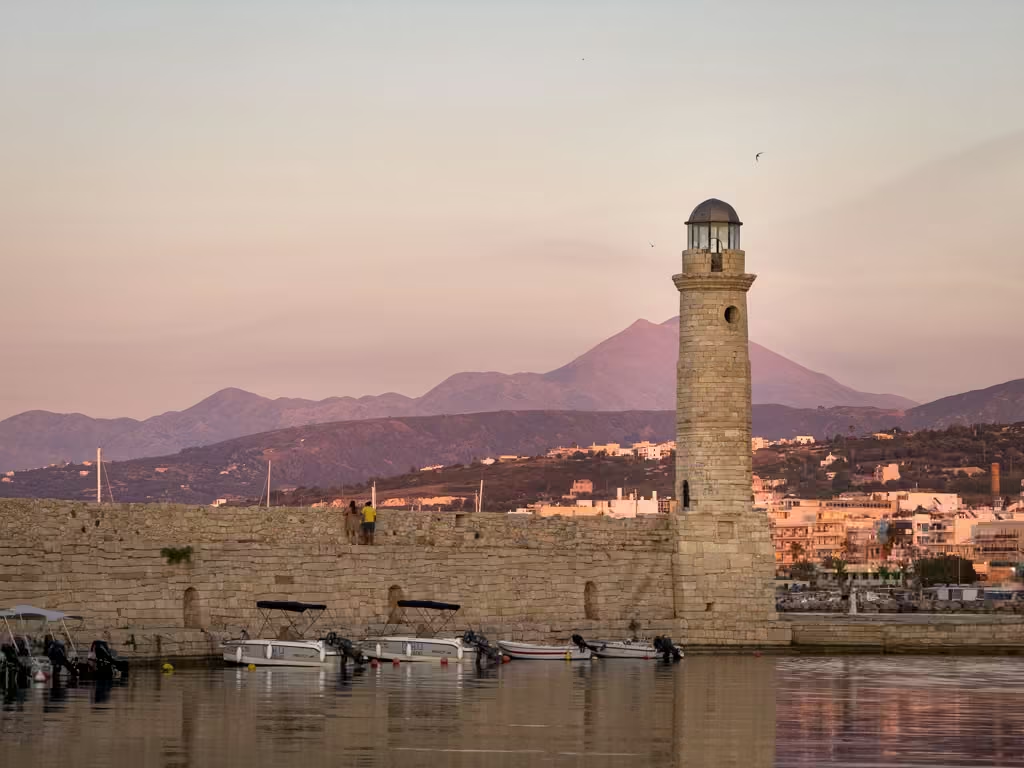
Most people start by asking “which Greek islands should I visit?” but the better question is how you want your trip to feel.
Because choosing Greek islands isn’t really about geography. It’s about the experience you’re chasing.
Do you want dramatic cliff views, iconic sunsets, and that quintessential postcard moment?
Do you want beach town energy, walkable harbors, and somewhere you can get lost in narrow alleys?
Do you want lush landscapes, turquoise water, and space to just breathe?
In Crete, we stayed in a quiet neighborhood in Rethymno’s old town where the same woman greeted us every morning like old friends.
That feeling of being woven into someone else’s ordinary day?
That doesn’t happen when you’re rushing between islands.
It happens when you slow down and let a destination actually find you.
My husband and I chose Santorini for our anniversary specifically because we wanted romance and quintessential Greece.
Cave hotel overlooking the caldera, sky turning pink and gold every evening.
It delivered exactly the energy we were after.
Mykonos delivered too, just a completely different energy.
Buzzy, high octane, beach clubs and late nights.
Couples might love a night or two of that vibe, but if you’re traveling with a teenager, a full stay in Mykonos probably isn’t the move.
Neither island is better.
They’re just completely different emotional experiences.
And honestly, that’s the fun part.
Greece has so many moods that you get to pick the one that matches yours.
If you’re debating Cyclades vs Ionian islands, it usually comes down to this:
White and blue drama and iconic sunsets → Cyclades
Green landscapes and the kind of turquoise water that will ruin every other beach for you forever → Ionian
Big variety, raw nature, and room for the whole family to explore without constant island hopping → Crete
Your gut will guide you better than any ranking ever could.
Step 4: Figure Out Your Greek Island Non Negotiables

This is where your shortlist actually starts to form.
The moment you identify one true nonnegotiable, half the islands eliminate themselves.
Because everyone has that one thing.
The moment they’ve been picturing since they first started dreaming about Greece.
And knowing what that is for you will point you straight to the right island.
Ask yourself:
Is seeing the caldera in Santorini non negotiable?
Do you need wide sandy beaches or swimmable water?
Are beach clubs and nightlife on the agenda?
Do you want to hike, drive, and explore? Is history a priority?
For me, the Acropolis was completely non negotiable on my first trip to Athens.
I’d actually already seen the Parthenon replica in Nashville, which is genuinely cool, but it’s concrete.
Standing in front of the real thing, made of marble, hauled up that hill thousands of years ago without a single crane or power tool?
No replica on earth prepares you for that feeling.
Athens went straight to the top of my list and has never moved.
And then there was Santorini, where I accidentally discovered that grilled octopus is one of the greatest foods on the planet.
That first plate turned into a personal tradition, and now I always prioritize islands known for strong food scenes.
Your non negotiable might be a sunset. Mine turned out to be a tentacle.
No judgment.
Here’s a quick cheat sheet to point you in the right direction:
Caldera sunsets → Santorini. There is nowhere else that exact view exists. Romantic, dramatic, and if you’re carving out a couples only portion of your trip, this is where you want to be.
Beach club scene → Mykonos. It’s loud, it’s fun, and it fully delivers. Just know what you’re signing up for. It’s a completely different vibe than Santorini even though people constantly lump them together.
Wide sandy beaches → Naxos. Some of the best beaches in the Cyclades, and because it’s less famous than Santorini or Mykonos, it’s far more relaxed.
If you’ve got a teenager who wants to actually swim and park themselves on the sand all day instead of posing on staircases, Naxos is the island.
Epic varied beaches and adventure → Crete.
Fair warning, you need a car. Crete is huge and the best spots are spread out.
But if your family wants a mix of wild Chania coastline beaches, mountain villages, and roadside tavernas where you’re the only tourists, nothing else comes close.
Turquoise Ionian water → Kefalonia or Zakynthos. The color of the water in the Ionian is a completely different thing from the Aegean.
If swimming is your family’s love language, this region will ruin you for everywhere else.
Ancient history → Athens, always Athens first. Not just because the Acropolis is extraordinary, but because it anchors your trip geographically.
Almost every ferry and flight connects through Athens anyway. It’s the logical starting point whether you like it or not.
Step 5: Think About How You Want to Get Around

This one sounds boring. It is not boring. It has derailed more than one Greece trip I know of.
Because some islands are completely walkable and car free living is the dream.
Others are massive, and if you don’t rent a car you will spend your whole trip in the same 3 square miles wondering why everyone else seems to be having a better time.
Ask yourself honestly: are you comfortable renting a car in a foreign country?
Do you want to just walk everywhere and not think about it?
Or do you want the freedom to find remote beaches and hidden villages on your own schedule?
I would not drive in Santorini if you paid me.
The roads are narrow, the drop offs are dramatic, and the parking situation in Oia is basically a competitive sport.
We skipped the car entirely, used the local buses (which were honestly wonderful), and booked transfers through Welcome Pickups when timing mattered.
Getting around Santorini without a car is genuinely easy. Zero regrets.
Naxos and Crete are a completely different story.
Renting a car on both islands is the move.
The buses will get you to the main towns but that’s about it.
The best beaches, the mountain villages, the moments that make you feel like you actually discovered something?
All off the main road.
If you’ve got a teenager in the backseat who wants to beach hop all day, a car in Crete or Naxos is the difference between “this is amazing” and “are we just staying in this town the whole time?”
Before you fall in love with an island, make sure your transportation comfort level actually matches the reality of getting around it.
Prefer no car, walkable, easy transport → Santorini, Mykonos, Paros
Comfortable driving, want to explore → Crete, Naxos, Kefalonia
When you start layering transportation on top of islands, regions, and ferry routes, it can feel like a lot of moving parts. That’s one of the first things I untangle in an itinerary review, because sometimes one small swap changes everything.
Step 6: Be Honest About Coming Back

Most people planning their first Greece trip operate under one assumption: this is it. One shot. See everything or regret it forever.
So they cram in 5 islands, spend one night at each, and arrive home exhausted, slightly resentful, and wondering why it didn’t feel as magical as they expected.
Y’all. I have seen this happen so many times.
I’m going to save you from that right now.
The moment I landed in Greece, I already knew I was coming back.
The people, the food, the way the light hits the water at 7pm and makes you forget you have a mortgage and a to do list back home.
Something about it just gets under your skin in the best possible way.
And I am not alone in this.
More than half the travelers I’ve worked with end up planning a second Greece trip within a year or two.
It’s just that kind of place. Greece doesn’t let you leave with a clean break.
It follows you home and whispers “so… next summer?” while you’re sitting in traffic on a Tuesday.
So if there is even a small chance you might go back (and trust me, there is), you do not need to see everything this time.
When you’ve spent months planning this trip and used precious PTO to make it happen, the pressure to see everything feels even bigger. Resist it.
Pick fewer islands. Stay longer. Come back for the rest.
This mindset shift is especially important when you’re choosing Greek islands as a first time visitor, because your first trip should feel memorable, not rushed.
And honestly, there are things about Greece that most first timers don’t think about until they’re already on the ground, so give yourself room to just be there.
Step 7: Balance Your Islands and Avoid Doubling Up on the Same Vibe

You’ve narrowed your region. You know your non negotiables.
Now the final puzzle piece is making sure your islands actually complement each other instead of repeating the same experience with a different postcard.
This is where a lot of itineraries quietly go wrong.
Pairings to avoid:
Mykonos and Paros: Both are stylish Cycladic beach towns with great food and nightlife energy. If you only have 10 days, pick one and spend more time there.
Paros and Naxos: Similar laid back atmosphere, similar beaches. They’re both wonderful but back to back they’ll start to blur together. Pick one unless you have extra time to spare.
Pairings that actually work:
Santorini and Mykonos: I know this pairing gets dismissed as overhyped.
I’m going to defend it anyway.
Santorini is dramatic, romantic, and built for slow mornings with caldera views.
Mykonos is buzzy, energetic, and built for beach clubs and late nights.
Back to back they give you two completely different Greek experiences, and the ferry between them is easy.
If you’re splitting your trip between couple time and family time, Santorini makes a gorgeous romantic few days while the rest of the crew hangs back in Athens or meets you on the next island.
Santorini and Naxos: Get your drama and romance in Santorini, then Naxos is like your best friend who lets her hair down.
We visited an abandoned hotel there, saw ruins tucked into the hillside, and just wandered without a plan.
It’s your deep breath after the glamour.
One moment you’re standing on white cliffs watching the sunset turn pink and gold, the next you’re eating fresh seafood at a taverna where locals actually eat.
Two completely different moods in one trip.
Athens and Crete: History and depth paired with raw natural beauty.
We always start in Athens, spending a couple of days strolling through Plaka and eating our way through the city, then fly straight to Crete for beaches, gorges, and mountain villages that feel like a different country entirely.
There are goats everywhere on those mountains and they are genuinely cool.
If your family wants variety without the stress of constant ferry hopping, this combo delivers.
The goal is contrast, not repetition.
Two islands that feel different will always leave you more satisfied than two islands that feel like the same trip copy pasted.
The 7 Step Framework at a Glance
Step 1: Start with your days. 7 days = Athens + 1 island. 10 days = Athens + 2 islands. 14 days = 2 to 3 islands max.
Step 2: Pick your region first. Cyclades (iconic, well connected). Ionian (lush, turquoise, separate logistics). Crete (big, needs its own time).
Step 3: Choose your vibe. Drama + sunsets = Cyclades. Green + swimming = Ionian. Depth + variety = Crete.
Step 4: Lock in your non negotiables. Caldera = Santorini. Beaches = Naxos. Nightlife = Mykonos. History = Athens. Adventure = Crete.
Step 5: Match your transport style. Walkable, no car = Santorini, Mykonos, Paros. Car needed = Crete, Naxos, Kefalonia.
Step 6: You’ll come back. Plan for this trip, not every trip.
Step 7: Balance your islands. Contrast over repetition. Every single time.
The 3 Questions to Ask Before You Book Anything
Before you commit to a single ferry ticket, run your shortlist through these:
Are my islands in the same region? If you’re mixing Cyclades and Ionian in a 10 day trip, you’re spending a significant chunk of your vacation in transit. Go back to Step 2.
Do I have at least 3 nights on each island? One or two nights sounds doable on paper. In reality you’ll spend most of it traveling and the rest of it wishing you could stay longer. Three nights minimum, always.
Does the transportation between them actually make sense? Not every island pair has a direct ferry.
Some connections require going back through Athens or taking a flight.
Check your routes before you fall in love with a sequence. I use Ferryhopper to check routes before I commit to anything.
If you answered yes to all 3, you’re in really good shape.
If you didn’t? Don’t panic. It just means something needs a small tweak, not a full restart.
Every island in Greece has something extraordinary waiting for you.
The magic isn’t in picking the “perfect” one.
It’s in how you combine them, how long you stay, and whether your trip has room to breathe.
Santorini will take your breath away.
Mykonos will surprise you.
Naxos will make you wonder why it isn’t more famous.
Crete will make you want to move there.
And the Ionian islands will ruin the color blue for you forever because nothing will ever look that turquoise again.
The only real mistake is cramming so many islands into one trip that you never slow down long enough to feel any of them.
Choose fewer. Stay longer. Let Greece do what Greece does.
You Don’t Need Every Island. You Just Need the Right Ones.
The goal was never to visit all 6,000 islands. It was to find the ones that fit your trip, your family, your travel style, and then actually be present when you get there.
You’ve got the framework.
You know your days, your region, your vibe, your non negotiables.
That’s more clarity than most people ever get before booking.
But if you’ve worked through all 7 steps and you’re still sitting with that quiet “will this actually work when we’re on the ground?” feeling, I get it.
Greece has a way of looking simple on paper and then throwing you a curveball with ferry schedules, driving logistics, or pacing that doesn’t quite flow.
That’s exactly why I offer itinerary reviews.
After 5 years of traveling Greece and helping dozens of readers put their trips together, I know where the hidden routing headaches are, which island combos create magic, and how to make 10 days feel like you got every last drop out of them.
You’ll land in Greece confidently, knowing your plan works.
Ready to lock in your islands and stop second guessing?
Frequently Asked Questions
How many Greek islands should I visit in 10 days?
Two islands plus Athens. That gives you 3 nights per island, time to actually settle in, and travel days that don’t eat your whole vacation. Trying to squeeze in a third almost always means one of them gets shortchanged.
What is the best Greek island for first time visitors?
Santorini is the classic first timer pick, and it earns it. The caldera views are unlike anything else in Greece and the island is easy to navigate without a car. That said, if beaches and a laid back pace matter more (especially with kids), Naxos is quietly one of the best first islands in the Cyclades. For families who want variety and don’t mind renting a car, Crete offers more range than any single island in Greece.
Should I visit Santorini or Mykonos first?
Mykonos first, Santorini second. Santorini’s pace is slower and more romantic, which makes it the perfect wind down after Mykonos’s energy. You get to finish your trip watching the sunset over the caldera, and that’s a hard feeling to beat as a final memory.
Is it better to fly or take a ferry between Greek islands?
Within the same region, ferry. Between regions, fly. Ferries are the most common way to hop between Cycladic islands because they’re close and well connected. But if you’re going from Athens to Crete or the Ionian, flying saves you hours. I use Ferryhopper to compare routes before I commit to anything. If the ferry is over 5 hours, I start looking at flights.
More Greece Travel Tips
- Greek Island Hopping Itineraries for 7, 10, and 14 Days
- How to Choose Which Greek Islands to Visit (Without Regret)
- How Greek Island Regions Actually Work (And Why It Changes Your Itinerary)
- How to Plan a Trip to Greece Without Losing Your Mind
- How to Plan a Santorini Trip Without Losing Your Mind
- Mykonos vs Santorini: Which Island Is Better for You?
- 30 Things to Know Before Going to Greece


